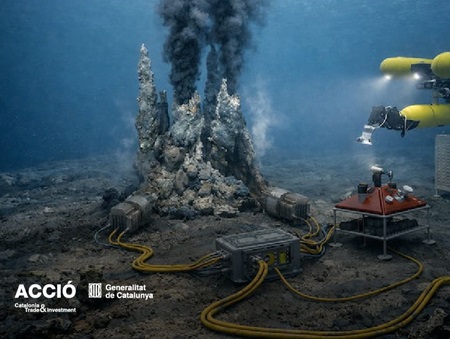
Catalan company PLOATECH, based in Girona, specializes in advanced engineering technology and scientific services for the underwater environment. The company has launched an innovative initiative to generate thermoelectric energy in submarine environments by harnessing the thermal gradient created by hydrothermal vents on the ocean floor. The system is designed to produce a continuous source of electricity capable of powering specialized batteries that supply energy to scientific instruments and permanent underwater observatories used for environmental monitoring. The project has been developed in collaboration with ViCOROB, the Computer Vision and Robotics research group at the University of Girona (UdG), which holds the TECNIO accreditation.
To carry out this innovative project, PLOATECH received support from ACCIÓ, the Agency for Business Competitiveness of the Government of Catalonia's Ministry of Business and Labour, through a €182,000 grant from its Green Business Research and Development funding programme focused on climate change. The programme is financed through the Catalan Climate Fund. ACCIÓ also provided the company with advisory services on the protection of its intellectual property and the technologies developed within the project.
Named LUCY (Long-term Underwater Thermoelectric Energy), the project is based on harnessing the energy potential of hydrothermal vents—cracks in the ocean floor that release superheated water and minerals. These vents are distributed throughout the world's oceans and are considered areas of exceptional scientific interest due to their unique ecosystems and their importance for climate change research and geological observation. However, continuous monitoring of these environments remains highly challenging because of the difficulty of providing a reliable and uninterrupted power supply.
According to Manuel Vial, co-founder of PLOATECH, "the lack of a stable energy source means that many underwater sensors currently have to ration their operating time or rely on costly ship-based expeditions or expensive and limited cabled infrastructure." Through the LUCY project, he adds, "our goal is to create an electrical outlet on the seabed capable of continuously powering scientific instruments, sensors and underwater robots, while also enabling these devices to recharge through subsea power generation stations."
The project has applications in ecosystem research and data collection for fields including geology, biology, biotechnology and the pharmaceutical industry. The technology could also contribute to the responsible future exploration of seabed resources by generating the scientific knowledge needed to minimize environmental impacts. In addition, LUCY has the potential to significantly reduce reliance on ship-based research campaigns, lowering operational costs, reducing greenhouse gas emissions and enabling lower-impact scientific research.
The project is currently at the proof-of-concept stage, with a functional prototype successfully validated under laboratory conditions. PLOATECH is now seeking funding for the next phase, which involves developing a prototype for testing in a real underwater environment. Once completed, the company estimates that, within approximately 18 months, it could have an operational system with strong commercial scalability potential.
PLOATECH is the first team in Spain developing a system of this kind specifically designed for long-term underwater operations. The company aims to validate the technology and become the first organization worldwide to successfully deploy such a solution.
As the coordinator of the LUCY project, PLOATECH leads the design and development of the thermoelectric power generation system and its prototypes. ViCOROB is responsible for integrating the system with underwater robotic platforms, including the development and validation of a docking station capable of recharging autonomous underwater vehicles.
Founded in 2017 and headquartered at the University of Girona Science and Technology Park, PLOATECH specializes in oceanographic services including remote sensing, robotics, underwater vehicles, data processing and scientific instrumentation. A multidisciplinary team of five professionals—including engineers, scientists and management specialists—has worked on the development of the LUCY project.

cloud technology axon

Sherpa.ai will use the proceeds to accelerate the development and depl...