Interview with Ángela Mancho, CEO of Phoenix Foods: We transform organic waste into sustainable proteins to drive the bioeconomy with the support ofCDTI Innovación
Phoenix Foods is leveraging biotechnology to transform organic waste into high-value resources. With the support of CDTI Innovación through the NEOTEC Women Entrepreneurs programme, the company is developing a solution based on the black soldier fly that converts agri-food industry by-products into proteins, oils, and fertilizers for applications in animal nutrition and agriculture.
Every year, millions of tonnes of organic by-products are generated by the agri-food industry, many of which are still treated as waste. At the same time, the growing global demand for protein is driving the search for more sustainable alternatives to conventional raw materials such as soy and fishmeal, whose production has a significant environmental footprint. Addressing both challenges simultaneously was the starting point for Phoenix Foods, a biotechnology company committed to turning a waste management problem into a new source of valuable resources.
The company was founded with the goal of bringing to an industrial scale a process that nature has been refining for millions of years. Its technology harnesses the remarkable ability of the black soldier fly to convert organic matter into proteins, oils, and natural fertilizers, promoting a production model based on the circular economy and waste valorisation. “We realised that nature had already solved this problem millions of years ago through the black soldier fly, one of the most efficient bioconverters that exist,” explains Ángela Mancho, CEO of Phoenix Foods.
The bioconversion revolution
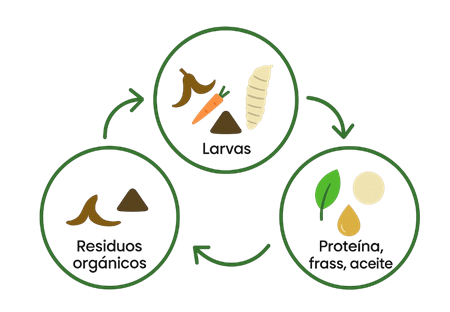
The project is based on a simple principle: transforming what is currently considered a by-product into a valuable new raw material. To achieve this, the company uses black soldier fly larvae fed with by-products from the agri-food industry that would otherwise end up being composted, landfilled, or incinerated.
In just a few days, the larvae consume the organic matter and convert it into three high-value products: a premium-quality protein for animal feed, an oil with a range of industrial and nutritional applications, and a natural agricultural fertilizer known as frass. The result is a process that maximises the use of available resources while significantly reducing the environmental impact associated with traditional waste management.
Compared with conventional systems, this process of bioconversion makes it possible to obtain marketable products without relying on energy-intensive treatments. Biology itself performs the transformation, closing the material loop and enabling far more sustainable production models. “With bioconversion, instead of treating waste by consuming energy and emitting CO₂, we let biology do the work and end up with market-ready products,” the CEO explains.
Industrialising a natural process
Although the biological principle is straightforward, scaling it up to industrial production represents a major technological challenge. Working with living organisms requires precise control of breeding conditions, feeding regimes, and colony development to ensure consistent performance and uniform product quality.
To meet this challenge, Phoenix Foods has developed a system that combines automation, continuous monitoring, and genetic improvement. Automation standardises production processes and increases productivity; continuous monitoring enables permanent control of environmental conditions and larval development; while genetic improvement focuses on selecting colonies that are increasingly robust, efficient, and better adapted to industrial production.
Together, these technologies optimise biological performance and ensure stable, consistent production—an essential requirement for manufacturing proteins at an industrial scale.
A Circular Economy with Real Impact
Beyond technological innovation, the company's approach addresses one of the key challenges of the bioeconomy: producing food and raw materials while reducing the consumption of natural resources. Instead of relying on a model based on cultivating new raw materials or importing them from other continents, the company focuses on making use of existing resources and returning them to the production cycle.
This approach is particularly relevant in sectors such as aquaculture. As Ángela Mancho explains, it represents “a paradigm shift: instead of waste being a cost with an environmental footprint, it becomes the raw material for marketable products. We reduce the carbon footprint, land use, and water consumption compared with conventional proteins, while enabling local and decentralised circular supply chains.”
For the company, sustainability is not an added feature incorporated once the product has been developed; it is the principle on which the entire technology is built. “Sustainability is not a marketing add-on in our business model—it is embedded in the very logic of the process, because every kilogram of protein we produce starts from something that would otherwise become waste,” says the CEO.
Beyond its industrial applications, this technology contributes to the transition towards a more sustainable production model aligned with the United Nations Sustainable Development Goals (SDGs). The reuse of organic by-products, the reduction of environmental impact, and the promotion of the circular economy directly support goals such as Responsible Consumption and Production (SDG 12), Climate Action (SDG 13), and Industry, Innovation and Infrastructure (SDG 9).
The Support of CDTI Innovación
As with most science-based companies, bringing a technology from research to market requires significant investment and long development timelines. “For Phoenix Foods, the NEOTEC programme has provided a major boost at a critical stage, helping us advance our technology and scale up our operations, while also serving as a mark of quality that opens doors with customers, partners, and investors,” says Ángela Mancho.
Beyond financial support, the CEO highlights the role that initiatives such as this play in promoting women-led scientific entrepreneurship in highly technology-intensive sectors. “Industrial biotechnology and deep tech remain fields where women are underrepresented, particularly in leadership positions and in science-based ventures.”
In this context, programmes such as NEOTEC Mujeres Emprendedoras from CDTI Innovación help narrow that gap. “Having a programme specifically designed to support innovative companies led by women is essential, and it paves the way for other female entrepreneurs. For me, as CEO, having that institutional backing is both an encouragement and a responsibility,” she says.
A Technology Set to Transform the Bioeconomy
The transition towards more sustainable production models is driving the development of new alternative protein sources and technologies capable of making better use of available resources. In this context, solutions such as the one developed by Phoenix Foods are expected to play an increasingly important role in transforming the agri-food industry.
However, the sector still faces significant challenges. Achieving greater competitiveness with conventional protein sources, ensuring a stable supply of raw materials, advancing the European regulatory framework, and fostering market acceptance will all be key factors shaping its development in the coming years.
For Ángela Mancho, the potential of this technology extends far beyond waste management. “I believe technologies like ours will become a cornerstone of the bioeconomy and food security over the coming decades, particularly in decarbonising the animal feed value chain. Demand for sustainable protein will continue to grow, and insect-based solutions offer a scalable and circular answer,” she concludes.
Image: Bioconversion process developed by Phoenix Foods
CDTI Innovación
The Centre for the Development of Technology and Innovation (CDTI E.P.E.), CDTI Innovación, is the innovation agency of Spain's Ministry of Science, Innovation and Universities. Its mission is to promote technological innovation within the business sector and to help Spanish companies generate and transform scientific and technological knowledge into globally competitive, sustainable, and inclusive growth.
In 2025, within the framework of its 2024–2027 Strategic Plan, CDTI Innovación provided €2.423 billion in support to Spanish companies and startups.
More info:
Internet
Web: www.cdti.es
Linkedin: https://www.linkedin.com/company/29815
X: https://x.com/CDTI_innovacion
Youtube: https://www.youtube.com/user/CDTIoficial

cloud technology axon

The transaction will enable Catalonia Hotels & Resorts to optimise its...