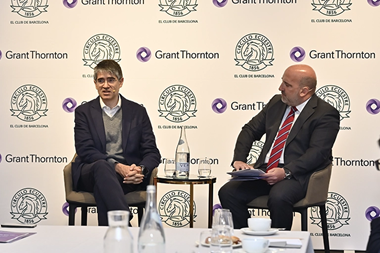
A strategic partner for growing companies and a driver of the economy. This is how Oriol Pinya, CEO of Abac Capital, defines the main roles of private equity. At the 1st “Protagonists Who Go Beyond” Meeting, organized by Grant Thornton and Círculo Ecuestre, the executive highlighted the evolution of private equity in Spain and its growing recognition by the public sector.
“In Spain, public programs have been launched that have been very useful in channeling funds. The public sector has understood that investing through professional managers makes more sense than doing it directly, because managing these companies requires specialization and the right incentives,” Pinya explained. These public programs represent “enormous support” for funds investing in Spain.
The founder of Abac Capital welcomed this paradigm shift, which in his view has a direct impact on a country’s GDP growth. “Economies with more private capital tend to be more dynamic, more innovative, and have a greater capacity for transformation,” he stated.
Regarding the value this practice brings at the business level, Oriol Pinya argued during the event that private equity has evolved from being merely a financial tool to becoming a strategic partner for companies.
According to him, when a company brings in private capital—whether through venture capital or private equity—it is not just gaining an investor providing funds, but also someone who contributes knowledge, contacts, vision, experience, and the ability to support growth. “Very often, the entrepreneur has built their company alone and suddenly finds a partner who helps them think, structure, and grow.”
During the event, which also featured Aurora Sanz, Managing Partner of Tax & Legal at Grant Thornton and board member of Círculo Ecuestre, and Jordi Santamaría, Head of Legal at Grant Thornton, Pinya emphasized the significant opportunity currently represented by Spanish mid-market family businesses.
This segment is made up of solid companies with strong track records, but which do not always have the necessary scale to compete globally. Added to this is the challenge of succession, as these companies often represent both the founder’s life project and a core part of their family wealth.
“This is where private equity can play a very useful role,” Pinya explained. “Not only by providing capital, but by helping these companies become more international, more digital, more sustainable, and stronger.” In this sense, the CEO of Abac Capital advocates for a long-term relational approach—getting to know entrepreneurs and sectors over time—combined with proactive deal sourcing supported by advisors and market contacts.
“We invest in very different sectors, and it would be absurd to pretend that we know each business better than the founder or management team. Our role is not to replace that knowledge, but to help organize it, challenge it, and expand it,” he explained. According to Pinya, private equity should contribute strategic reflection, professionalization of management, identification of acquisition targets, and talent attraction.
When asked about the most common mistakes in the sector, Pinya distinguished between exogenous factors—such as COVID-19, which affected otherwise sound investments unpredictably—and endogenous errors. Among the latter, he highlighted one recurring issue: arrogance.
“Thinking you know more than you actually do. Convincing yourself that you will fix a company just because you come in. Believing that a company that wasn’t growing will suddenly start growing. Or thinking you can do without the founder too early.” In companies where the business depends on the knowledge, relationships, or intuition of a specific individual, removing that pillar prematurely can leave the company vulnerable, he explained.
Pinya also analyzed the current environment with a striking metaphor: “I often joke that black swan events used to appear occasionally, and now it feels like one appears every two weeks.” In an increasingly interconnected system, volatility is amplified, and valuing a company—bringing future cash flows to present value—becomes much more difficult when the macroeconomic environment is unpredictable.
In this context, he identified two major structural trends that will shape the business ecosystem in the coming years. The first is artificial intelligence: “I think it’s a spectacular transformation. Just as we once had to learn how to use Excel, PowerPoint, or the internet, now we need to learn how to work with AI.”
The second major trend is sustainability, understood not as a reputational add-on, but as a real transformation of business models. Large listed companies are more advanced, partly due to regulation, but these requirements are already reaching SMEs. “Private equity can do something especially valuable here: take an SME and help it become more digital, more sustainable, more professional, and better prepared to grow.”
Regarding the future of the sector, Pinya was unequivocal: “Spain needs more private capital, not less. When it works well, it’s not only the investor or the entrepreneur who benefits—the entire economy benefits.”
The 1st “Protagonists Who Go Beyond” Meeting is part of a new series launched by the professional services firm Grant Thornton in collaboration with Barcelona’s Círculo Ecuestre, with the aim of bringing closer the leaders behind Catalonia’s leading companies—leaders who make a difference in their sectors and highlight their business projects through excellence, vision, and impact.

cloud technology axon
Over little more than a decade, Regenera has built a strong track reco...