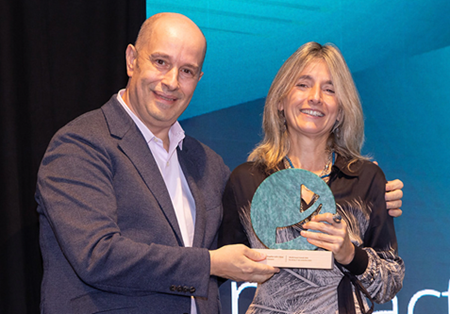
Impact Champion – Ship2B Impact Awards 2025
María Ángeles León is one of the pioneering figures in advancing impact investing in Spain. An economist by training, she began her career in the corporate world before shifting her professional path towards strategic philanthropy and financing solutions to major social and environmental challenges.
She is co-founder of Open Value Foundation and Global Social Impact Investments, initiatives through which she has promoted models that combine philanthropy, entrepreneurship, and investment to generate sustainable impact, particularly in developing countries. Throughout her career, she has actively contributed to strengthening the impact ecosystem in Spain and Europe, promoting a vision in which capital becomes a tool to transform society.
You have been recognized as Impact Champion at the Ship2B Impact Awards 2025, held within the framework of the XII Ship2B Impact Forum. What does receiving this recognition within the impact ecosystem mean to you, and what moments from your career came to mind when you received it?
It feels like reaching the highest point I could have imagined. I remember the first Ship2B speakers and awardees, who were my idols and people I have learned so much from. I also thought about our first investments in projects accelerated by Ship2B, alongside Xavi Pont and Guillermo Sarriás, and the Open Value Foundation team with María Cruz Conde, Arturo García… We continue with the same enthusiasm, although with more grey hair and much more knowledge.
Your career began in the corporate world before transitioning into social impact. Looking back, what experiences or personal motivations set you on this path?
I believe social vocation is something you are born with. Everyone feels, to a greater or lesser extent, that pull towards others. Life circumstances also play a role, and it was one of my managers, after early retirement, who told me: “If you have a project in mind, take the leap now, before it’s too late.” So since 2018 I have dedicated myself fully to our foundation, OVF, and especially to our impact investment management firm, GSI.
For many years you were closely involved in traditional philanthropy. What lessons did that stage leave you, and what made you start questioning whether that model was sufficient to address complex social problems?
Since we got married, Paco and I allocated part of our income to philanthropy, but it was not until 2004 that we began to question it. We felt that philanthropy alone was not enough, and that over the years we had created dependency relationships and very limited development.
Across your career you have worked with entrepreneurs, investors, foundations, and social organizations in very different contexts. What personal lessons have marked you most?
The fundamental lesson is that it is difficult to combine the investment mindset with that of the non-profit sector, but that is precisely what our work is about: finding the intersection between these two realities and ways of working. It is an evolution of both sectors that requires a great deal of understanding—and time, and time, and time.
“Seeing how an opportunity, where none existed before, transforms lives and enables people to grow in dignity and freedom.”
Driving solutions to social problems is often a long and uncertain journey. What has motivated you to continue pursuing this path for so many years?
The impact on people’s lives. Seeing how an opportunity, where none existed before, transforms lives and enables people to grow in livelihoods, dignity, and freedom. The more opportunities for employment and improvement of livelihoods we can generate, the freer and happier we can become.
You have been one of the key figures in promoting impact investing in Spain. What convinced you that combining capital and impact could be a powerful tool for social change?
In 2004 I became aware of the work of Acumen and its founder Jacqueline Novogratz, who pioneered “patient capital” 25 years ago. Also, what former World Bank President Jim Yong Kim said in 2018: that the tools that generate development are the same ones that made developed countries wealthier—entrepreneurship, savings, and investment. And then experience itself: continuously testing and proving over many years that this truly works.
Philanthropy, venture philanthropy, and impact investing are often seen as distinct approaches. From your experience, how should these models complement each other to address complex social challenges?
Philanthropy should focus on challenges that cannot be solved through business models, such as emergencies, very early-stage investments, and technical assistance. The difference between venture philanthropy and impact investing does not really exist: both use the same investment tools as traditional finance. What changes is whether the actor is a third-sector organization or a private-sector entity.
“The companies that truly generate impact are those where there is a genuine intention to improve the lives of vulnerable people.”
One of the major debates in impact investing is how to measure real impact. From your experience, how important is measurement in distinguishing authentic impact from other forms of responsible investing?
I believe the key point was made by whoever first spoke about “intention,” which, being so subjective, is very difficult to measure. After so many years and so many types of companies invested in, I believe that companies that truly generate impact are those whose founders and management teams have a genuine intention to improve the lives of vulnerable people, and where, just like profit maximization, this intention guides daily decision-making.
Despite progress in frameworks and methodologies, many investors still see impact measurement as one of the sector’s biggest challenges. Do you think we are moving towards clear standards, or is there still a long way to go?
Much progress was made in environmental taxonomy and standards, which are now being questioned, and even fund classification is being reconsidered. So I would say we are, in a way, back at square one. On the social side, no taxonomy was ever properly defined, so we are still in uncharted territory. Initiatives such as IRIS+ or Impact Management Project are not yet market standards, although they remain the best reference we currently have.
“An investor aiming to maximize impact per euro invested will find greater efficiency in developing countries.”
A significant part of your work has been linked to projects and investments in developing countries. What have these contexts taught you about generating impact effectively?
The main factor in developing countries is that starting points in terms of wages, housing access, and basic goods and services are among the lowest in the world, so the impact of a well-targeted investment on people is greater. If we compare the financing required to achieve similar outcomes in developed countries, it is significantly higher. Therefore, an investor seeking to maximize social impact per euro invested will find more efficiency in investing in developing countries.
When we talk about development, it is often framed in terms of aid or international cooperation. What role can entrepreneurship and investment play in creating sustainable economic opportunities?
Most of our impact investing experience has been in Sub-Saharan Africa, so bringing impact investing to Spain was a natural evolution for us, applying the same tools to generate opportunities for vulnerable groups in Spain as we have used for many years in African countries.
In a global context marked by geopolitical tensions, rising inequality, and major social and environmental challenges, how do you think this situation may affect the development of impact investing?
As an incorrigible optimist, I believe we can turn this risk into an opportunity. It is true that large asset managers and financial institutions are pulling back from sustainable investment, leaving many investors without attractive options to achieve more than financial returns. However, impact funds continue to do the same—and with even stronger conviction. I believe there will come a time when this wave of investors moves closer to impact funds. We must continue working well, delivering returns, and remain patient.
Looking ahead to the coming years, how do you envision the evolution of impact investing?
It will undoubtedly grow, and it places a huge responsibility on existing impact funds to deliver both expected returns and impact.
The trajectory of María Ángeles León reflects the transformative potential of impact investing to change lives, mobilize capital toward real solutions, and build a more inclusive and sustainable economy.
Interview by Fundación Ship2B

cloud technology axon
This transaction reinforces Alantra’s continued momentum in Aerospac...