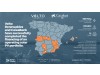
Despite the uncertain geopolitical context and the impact of tariff measures on global trade, the outlook for the Agribusiness sector in the Iberian Peninsula remains positive. A strong start to the year and growing investor appetite point to a market rebound, with the expected closing of deals that were delayed or paused last year. The Iberian Agribusiness Report, published by CBRE, shows that institutional investment up to May exceeded €400 million—half of all transactions in Iberia in 2024.
Although investment slowed last year due to price misalignments and regulatory complexities, the total institutional investment volume in Iberia between 2022 and 2024 has surpassed €4.1 billion. These figures highlight the sector’s appeal, which is characterized by lower volatility compared to other traditional and alternative assets. In recent years, institutional investment has been driven by attractive long-term returns and the ability to develop diversified portfolios.
Institutional capital now accounts for half of all investment in the Iberian agribusiness sector.
The report reveals that agribusiness-specialized funds—typically based in the US, Canada, and the UK, with a long-term perspective and seeking large-scale investments—represented 25% of the capital invested between 2022 and 2024. They are followed by generalist funds, which accounted for 14% and are seeking to diversify their portfolios by starting or gradually increasing their exposure to the sector. Family offices represent 10% of investment, mainly targeting small to mid-sized tickets.
Meanwhile, industrial producers/traders, both Iberian and international, accounted for 51% of the capital invested in the sector during these years. These players tend to expand their operations into new locations—for instance, in the fresh fruit segment—to complement their year-round production windows.
In 2024, Iberia reached the top position in agricultural production value in Europe, achieving record-breaking figures. It is the most institutionalized investment market in the region, with increasing geostrategic appeal.
"The professionalization of the sector is encouraging the entry of diverse types of players into a market that continues to grow," says Manuel Albuquerque, Head of Agribusiness for Southern Europe (Spain, Portugal, and Italy) at CBRE.
Capital allocation to agribusiness is growing year after year
The increasing sophistication across the entire value chain, greater specialization, and strong returns over recent decades are key factors driving investment in the agricultural sector. Globally, CBRE has observed a steady rise in funds raised since the year 2000—when investment volumes were negligible—reaching over €200 billion in cumulative capital raised by last year. Strategies are becoming more diverse: while versatile private equity still leads fundraising, farmland funds are not far behind, and both venture capital and AgTech funds are gaining ground.
North America remains the region with the highest number of funds and the largest amount of capital raised to date, followed by Europe, where the average ticket size per fund is higher (around €300M).
The transaction volumes recorded in Iberia show how Southern Europe is solidifying its position as a strategic region for agribusiness development.
Iberia is one of the few regions in the world where it is possible to invest in high-value crops within an attractive environment marked by lower volatility, strong returns, and manageable risks. Water is a key element: 20% of arable land in Iberia and Italy is irrigated, compared to just 5% in the rest of Europe. Other important factors include climate, soil quality, and farm size, all of which make Iberia and Italy a compelling and viable investment opportunity in the sector.
Grain cereals and olive groves are the most extensively cultivated crops in the Iberian Peninsula, with approximately 5.9 million and 3 million hectares respectively. In the case of nuts (almonds, pistachios, walnuts, etc.), the cultivated area grew by nearly 300,000 hectares between 2013 and 2023. Over the past year, the land area dedicated to olives and nuts (particularly pistachios in Spain and almonds in Portugal) has increased, while vineyard acreage has declined. In Spain, the area devoted to citrus fruit has shrunk, whereas avocado production is gaining importance in Portugal.
Product prices have seen significant fluctuations, especially in year-round crops like olive oil, which dropped by 55% over the last twelve months, and almonds, which rose by 69%. Among seasonal products, the average price of avocados fell from €2.59/kg in the 2023/2024 season to €2.06/kg in 2024/2025. Tree oranges saw an 11% drop in their average price. On the other hand, tomatoes rose by 25%, followed by strawberries (+19%) and blueberries (+18%).
Agricultural land prices vary across Iberian regions
After five years of widespread land price increases, a stabilization trend is now emerging in more mature markets. However, certain areas in Spain—such as northern Cáceres, Aragón, and the drylands of Cádiz—as well as Portugal’s Ribatejo region, continue to experience price increases of over 10%.
Factors such as slope, climate, soil quality, and above all, water availability, strongly influence price variations. Nonetheless, irrigated land still offers clear long-term appreciation potential, as its supply is limited, essential, and non-depreciable. CBRE expects short-term price movements to moderate, leading to greater alignment between buyers and sellers in 2025.
To download the full report, please follow this link.

cloud technology axon

MAD creates, produces and distributes large-scale immersive cultural e...