In an era where startups scale in months and technology globalizes in weeks, the most transformative social solutions still seem stuck. Organizations that improve youth employability, reinvent education for vulnerable groups, or generate real social impact often struggle to scale.
Why is it so difficult to expand the reach of impact solutions that already work?
At Fundación Ship2B, we address this question by supporting organizations that have already demonstrated impact but face barriers—structural, financial, or capacity-related—when attempting to grow.
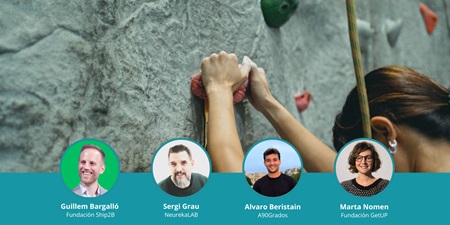
In this article, we speak with Guillem Bargalló, Program Manager at Fundación Ship2B; Sergi Grau, Co-founder of NeurekaLAB; Álvaro Beristain, CEO and Co-founder of A90Grados; and Marta Nomen, Director of Fundación GetUP. They all participated in the 4th edition of Scale4Impact, a program co-designed with Bikai to accelerate and fund the growth of social impact projects focused on education and employment.
Through their insights, we explore lessons learned and seek to understand what it takes to scale social impact, particularly in the areas of education and employment.
Structural barriers that hinder the scalability of social impact
Scaling a solution is not just about replicating it. It requires a clear value proposition, a well-defined strategy, the ability to measure impact, a prepared team, key partnerships, and financial resources.
Numerous studies indicate that many social innovations with proven impact fail to scale due to persistent structural barriers. A report published by the Stanford Social Innovation Review, led by Kriss Deiglmeier and collaborators, identifies three main obstacles: lack of appropriate capital, insufficient organizational capacity, and unfavorable institutional environments.
1. Lack of appropriate capital to scale
It is not just about securing more funding, but the right kind of funding. Many organizations access pilot funds or initial grants but struggle to find patient, flexible, long-term capital to grow. This mismatch creates what the study calls “the missing middle”: projects with proven impact that cannot take the leap to scale.
2. Insufficient organizational capacity
Many organizations are founded to solve a problem, but not necessarily to grow. Scaling requires new internal capacities—leadership, governance, talent management, and rigorous impact measurement—that are not always present or prioritized. This represents one of the most significant barriers.
Guillem Bargalló of Fundación Ship2B highlights that one key bottleneck is precisely the lack of organizational culture and scalability in the social sector. “In the world of impact, we often find people who are specialists in the problem but not in running—or scaling—an organization or enterprise.”
This lack of business management knowledge and experience in organizational growth can overwhelm the proposed solution or limit its execution to a local scope. Unfortunately, some solutions never reach all the people who could benefit from them.
Moreover, many initiatives focus on addressing a specific social challenge without building a foundation for sustainable growth. Bargalló notes, “When you grow, you can no longer rely on the founding team to do everything. You’ll need to bring in new people, maintain a structure, manage fixed costs, and ensure your impact reaches more individuals or communities.”
Ship2B supports organizations precisely in developing these capabilities: thinking about scalability from the outset. This includes defining the value proposition, designing the business model and product lines, developing financial plans, preparing for investment, articulating an impact narrative, and projecting a medium- and long-term vision.
While not all projects need to scale, those offering innovative, replicable solutions should have the opportunity. Achieving this requires training, support, and resources—exactly what Scale4Impact and other Ship2B venture philanthropy programs provide.
3. Unfavorable institutional and systemic environments
Finally, the report notes that even the most effective solutions can be blocked by institutional context: rigid regulations, lack of supportive public policies, or challenges in collaborating with government agencies can hinder the growth of high-value social projects.
The conclusion is clear: scalability depends not only on a good solution but also on an ecosystem that allows and supports growth. “It’s not enough to have impact: you need to structure it to grow, measure it rigorously, and communicate it clearly,” Bargalló emphasizes.
Solutions focused on the financing barrier
In this fourth edition of Scale4Impact, discussions with finalist organizations revealed that the main barrier is financing. More specifically, the challenge lies not only in accessing resources but in having economic models that sustain and scale impact over time. Some organizations have addressed this by designing self-sustaining and diversified funding strategies from the outset.
Álvaro Beristain of A90Grados summarizes: “We chose a self-financing model in our early stages because it gave us autonomy and freedom to design the project our way, forced us to be sustainable from the start, and strengthened our credibility by demonstrating that the project was viable not only socially but also financially.” He adds, “Venture philanthropy provides the boost needed to continue growing and investing in areas we want to strengthen, consolidating a solid and sustainable structure over time.”
Marta Nomen from Fundación GetUp explains their hybrid model: “GetUp seeks more self-sustaining models to ensure continuity, expand our impact, reduce dependence on donations, and become a change-making organization capable of generating revenue from service delivery and partnerships with companies and public institutions.”
NeurekaLAB has explored alternative funding approaches to drive growth. Co-founder Sergi Grau explains: “We decided to explore financing models beyond traditional venture capital because diversification gives us agility and strategic freedom. Since our project has clear social impact, financial returns are usually slower than in conventional businesses, making access to bank loans or purely profit-driven funds difficult. Venture philanthropy aligns investment with purpose: it provides patient capital, strategic support, and a vision committed to real social impact, not just financial return, facilitating sustainable growth.”
What is Venture Philanthropy?
Venture philanthropy combines impact-oriented investment, patient capital, and strategic support. Unlike traditional philanthropy, which focuses solely on donating money without accountability, venture philanthropy empowers social organizations to be sustainable, effective, and scalable—a powerful tool to fund the growth of high-impact projects.
Five growing projects with potential to scale their impact
Some initiatives are already generating tangible social and environmental impact but still have room to expand. These projects offer proven solutions, replicable models, and a clear growth ambition, capable of addressing complex challenges if given the right resources and conditions. Examples include:
Scaling impact is possible: what it takes is will
Scaling social innovation is not just a strategic matter—it’s about the world we want to create. If a solution transforms lives, we must do everything possible to bring it to more people. Fundación Ship2B, through Scale4Impact, continues to promote a model of impact, sustainability, and partnerships that makes this possible.

cloud technology axon
Santander Corporate & Investment Banking has acted as Financial Adviso...