
AI-driven M&A is the use of artificial intelligence —especially generative AI— across deal sourcing, due diligence, valuation and integration to make transactions faster, cheaper and better-informed. Artificial intelligence has moved from the margins to the core of mergers and acquisitions. What began as experimental document-review tools is now a layer of capability that touches every phase of a transaction.
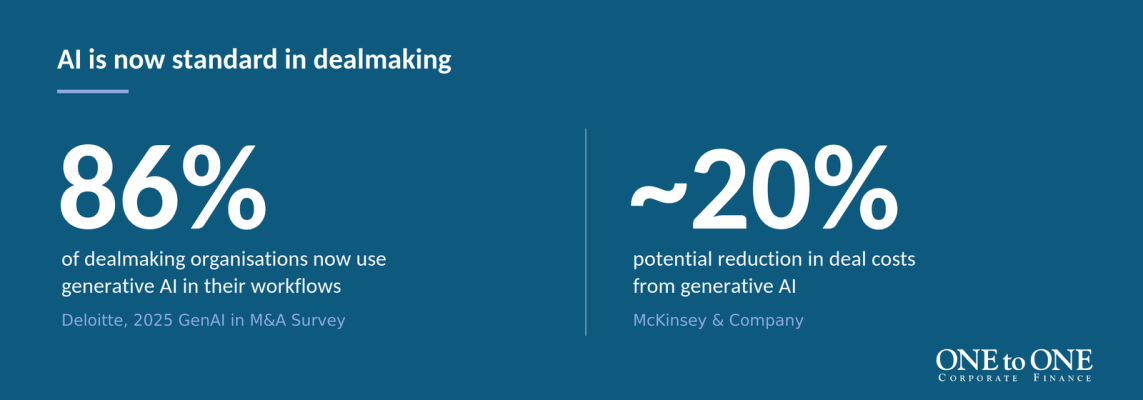
According to Deloitte’s 2025 GenAI in M&A Survey, around 86% of corporate and private equity dealmaking organisations have already integrated generative AI into their workflows —most of them within the previous year. For founders and advisors involved in a sale or acquisition, understanding how AI is deployed across the deal cycle is no longer optional: it shapes price, speed and risk in real time.
How does AI improve deal origination and target screening?AI expands deal origination by scanning market signals, mapping adjacent companies and scoring pipeline quality far beyond what manual research can reach. For decades, sourcing meant manual research, sector mapping and personal networks. AI dramatically widens both the breadth and the depth of that work.
Three capabilities are reshaping origination:
For sellers, this means potential buyers may already know about your company, your growth trajectory and even your strategic vulnerabilities before any banker picks up the phone. Read more: Key criteria for buyers search in M&A.
Read more: Key criteria for buyers search in M&A.
How is AI changing due diligence?
In M&A, AI-powered due diligence uses machine learning to review contracts, flag financial anomalies and assess cybersecurity risk in a fraction of the time of manual review. This enables more comprehensive reviews while freeing advisors to focus on strategy and deal structuring. Due diligence is where AI is already producing the most measurable gains —McKinsey estimates generative AI can cut deal costs by roughly 20%.
At the same time, AI itself has become a key diligence area. Buyers increasingly scrutinise four things in a target’s AI:
For sellers, strong AI governance and clean data practices are becoming critical drivers of enterprise value.
How does AI affect valuation and negotiation?AI capability is now a meaningful component of valuations —both as upside (genuine AI revenue, defensible models, proprietary data) and as risk (reliance on third-party providers, exposure to commoditisation). Recent industry analysis shows this is especially pronounced in software deals.
For advisors, this creates four practical considerations:
Read more: The process of buying a company: the indicative offer.
Read more: The process of buying a company: the indicative offer.
How does AI create value after closing?After closing, AI helps acquirers capture synergies faster by mapping redundancies, accelerating data migrations and tracking integration KPIs in real time. Historically, integration is where most M&A value is lost. AI is changing that stage too.
Leading acquirers now use AI to:
For private equity sponsors in particular, AI has become a core value-creation lever within the holding period, not just a tool used during diligence.
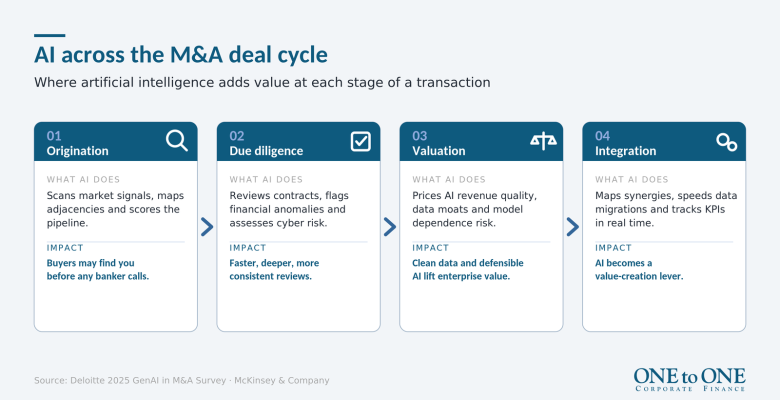
AI across the deal cycle at a glance|
Deal phase |
What AI does |
Impact for sellers / buyers |
|
Origination |
Scans signals, maps adjacencies, scores pipeline. |
Buyers may know your company before any banker calls. |
|
Due diligence |
Reviews contracts, flags anomalies, assesses cyber risk. |
Faster, deeper reviews; AI governance now drives value. |
|
Valuation |
Prices AI revenue quality, data moats, model risk. |
Clean data and defensible AI raise enterprise value. |
|
Integration |
Maps synergies, speeds migrations, tracks KPIs live. |
AI becomes a value-creation lever, not just a diligence tool. |
Conclusion: are you ready for the new deal environment?
AI is reshaping the entire M&A process —enabling faster sourcing, deeper analysis and more efficient integration— but successful deals still depend on human judgement, negotiation and trust. For sellers, this creates both opportunity and scrutiny: strong governance, clean data and well-managed AI systems can increase valuations, while hidden risks are identified earlier and priced into deals.
For buyers, the advantage no longer comes from access to information, but from the ability to interpret and act on it. AI is becoming the operating system of the deal cycle. The key question for both sides is no longer whether AI will impact M&A, but whether they are prepared for the new environment it has already created.
Frequently asked questionsAI is used across the entire deal cycle —sourcing, due diligence, valuation and integration— to surface targets, review documents, assess risk and model scenarios faster than manual work.
In origination, NLP scans signals to find owners open to selling; in due diligence, AI reviews contracts and flags anomalies; in valuation, it prices AI revenue quality and data moats; and in integration, it maps synergies and tracks KPIs in real time.
What percentage of dealmakers use AI in M&A?According to Deloitte’s 2025 GenAI in M&A Survey, around 86% of corporate and private equity dealmaking organisations have integrated generative AI into their workflows.
Adoption is heaviest in pre-deal activity, while post-deal (integration) use is growing more slowly. The direction of travel is clear: AI is becoming a standard layer of the deal process rather than an experiment.
Does AI increase or decrease company valuations in M&A?AI can do both: genuine, defensible AI capability raises valuations, while hidden AI risks (IP, licensing, privacy, model dependence) can reduce them or kill a deal.
Buyers reward recurring AI revenue tied to proprietary data and strong governance, and penalise reliance on third-party models or unclear data ownership. For sellers, clean data and solid AI governance are increasingly value drivers.
How does AI speed up due diligence?AI automates contract review, detects financial anomalies and assesses cybersecurity risk, enabling broader, more consistent reviews in a fraction of the manual time.
This lets advisors shift their time to strategy and deal structuring. McKinsey estimates generative AI can cut deal costs by roughly 20%. At the same time, the target’s own AI has become a key diligence area in itself.
What should sellers do to prepare for AI-driven M&A?Sellers should put in place strong AI governance, clean and well-documented data, and clear ownership of models and IP before going to market.
Because buyers increasingly screen these factors early, getting them right protects valuation and avoids surprises in diligence. Well-managed AI assets can become a positive differentiator rather than a source of discount.
About ONEtoONESelling or acquiring a company is a complex process that benefits from specialised advice. At ONEtoONE Corporate Finance, we combine deep sector expertise, proprietary technology and a global reach across more than 50 countries to help business owners maximise the value of their transactions. If you are considering a sale, an acquisition or a strategic move involving AI-driven assets, get in touch with us for a confidential consultation.

cloud technology axon
Axon Partners Group, Tresmares Capital, Sabadell Venture Capital, Inve...