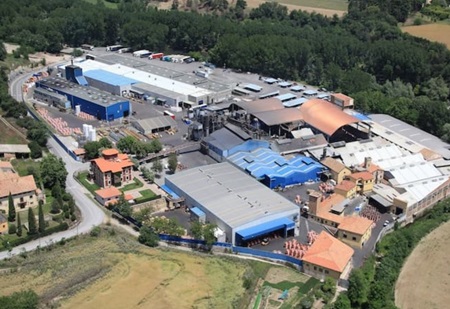
The Catalan company La Farga (Les Masies de Voltregà, Osona), a leader in copper recycling and the manufacturing of products and semi-finished goods made from this material, has launched an innovative project to make use of slag generated during the copper refining process. Specifically, the company aims to validate, together with the Polytechnic University of Catalonia (UPC), the use of this slag as new materials for cement production, with the goal of optimizing the use of natural resources and assessing its potential as a substitute material. In this way, the company seeks to promote the circular economy in both the copper and cement industries.
To carry out this innovative project, La Farga has received support from ACCIÓ —the agency for business growth under the Department of Business and Labour— through €346,000 from the Green R&D funding line for circular economy projects in the field of waste, which is also co-funded by the Catalan Waste Agency.
According to La Farga’s Director of R&D&I, Núria Ferrer, “copper is a strategic metal for sustainable development because it can be recycled infinitely without losing its properties, and, in addition, processing recycled copper saves 40 million tonnes of CO₂ annually, equivalent to reducing the emissions produced by 16 million cars on the road.”
Within the company’s operations, Núria Ferrer explains that “the copper refining process is the stage in which the raw material is transformed and the purity level of the metal is increased to meet regulatory requirements, and during this process slag is generated.” “This project is part of La Farga’s commitment to continue advancing its circularity model, seeking new solutions that allow value to be added to by-products of the production process and to minimize waste generation,” she emphasizes.
In this context, La Farga, together with the UPC, has developed a process that allows the recovery of copper content present in the slag, enabling the company to reuse it. Subsequently, within the framework of the project, the company aims to demonstrate the use of this slag—until now considered waste—as new materials that could have properties similar to those of other materials such as clinker, aggregates, or certain additives needed for the production of cement or multifunctional concrete, which are currently made from natural resources.
In this way, La Farga seeks to revalorize this slag for high value-added industrial applications, such as conductive cements used in the construction of road pavements or industrial sensing products. These materials require a certain level of electrical conductivity to allow signal transmission, a property that La Farga’s slag could potentially provide if its use as a new sustainable material is validated.
According to La Farga’s ESG Manager, Maria Riera, with this project the company aims to “create shared value and promote collaborative ecosystems that integrate multiple actors along the value chain.” “As an industry, we have the responsibility to make the world more sustainable, and projects like this, through public-private collaboration, make this more achievable,” she adds.
The research and development phase of the project with the UPC has already concluded, although the Director of R&D&I at La Farga notes that “even so, we are constantly exploring new applications that may emerge in such a rapidly changing world.” The project is currently in the industrial testing phase, with the aim of validating that the study results are scalable at an industrial level.
La Farga is a family-owned industrial company founded in 1808, headquartered in Les Masies de Voltregà (Osona). It is characterized by a strong commitment to innovation in the service of sustainability and has developed its own technology within the copper recycling process, with its first patent registered in 1986. The company currently employs 420 people and exports its products to more than 40 countries. It reported a turnover of €1.534 billion in 2024.
La Farga aims to revalorize this slag for high value-added industrial applications, such as conductive cements used in the construction of road pavements or industrial sensing products

cloud technology axon

The transaction will enable Catalonia Hotels & Resorts to optimise its...