The value of M&A transactions in private markets increased from US$13 billion to US$27.2 billion between 2023 and 2025. According to The Race for Scale in Private Markets, a new report by Oliver Wyman, asset managers are accelerating strategic transactions to achieve greater scale, broaden their capabilities and strengthen their competitive positioning in one of the fastest-growing segments of the asset management industry.
Assets under management (AuM) in private markets are expected to grow by approximately 12% per year over the next five years, compared with an estimated 8% annual growth for public market assets. While traditional asset classes continue to face pressure from fee compression and slower growth, private markets have become increasingly strategic for leading asset managers and are emerging as one of the most active areas for M&A activity.
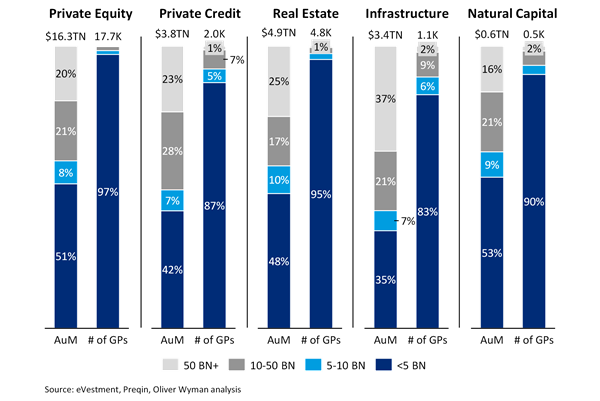
However, the market remains highly fragmented. Around 97% of private equity managers, 87% of private credit managers and 95% of real estate managers oversee less than US$5 billion in assets, even as fundraising becomes increasingly concentrated among a small number of firms. Managers with more than US$10 billion in assets under management increased their share of global fundraising from 42% between 2000 and 2005 to 54% over the past five years, highlighting an industry that increasingly rewards platform breadth and institutional scale.
Figure 1. Number of Managers by Asset Class and Assets Under Management (2025)
The report identifies three key factors driving the current acceleration in industry consolidation.
The first is scale, which has evolved from a competitive advantage into a prerequisite for success. Larger asset managers not only attract more capital, but also benefit from broader distribution networks, greater ability to recruit and retain talent, and the risk management, compliance and portfolio management infrastructure demanded by large institutional investors.
The second is product breadth. Since 2005, the world's 20 largest private market managers have increased the average number of active investment products they offer by a factor of six, expanding beyond flagship funds to develop multi-strategy platforms spanning private equity, private credit and other private market asset classes. This enables them to support investors across different stages of the investment cycle while offering solutions tailored to varying risk-return profiles.
The third is the ability to consistently assess and manage investments throughout the market cycle. This capability is becoming increasingly important as financing conditions tighten across certain market segments and a significant refinancing wave is expected over the next two to three years.
Creating Value Through Strategic M&A
As consolidation accelerates across private markets, asset managers are increasingly focused on how strategic combinations can create long-term value. In most transactions, value creation revolves around five principal levers:
However, growth through M&A alone does not guarantee superior performance. Only around half of all asset management transactions achieve a measurable improvement in the combined firm's cost-to-income ratio.
Those combinations that have consistently created value share three common characteristics: a clearly defined strategic rationale from the outset, integration planning that begins well before completion, and careful management of the acquired firm's talent and organisational culture.
The most successful transactions clearly identify the capabilities that need to be strengthened, establish realistic synergy expectations and define a coherent operating model from the very beginning. In an industry where much of the value resides in people, preserving key investment professionals and maintaining investment continuity is just as important as achieving greater scale.
"Private markets have entered a new phase of consolidation in which scale is no longer simply a competitive advantage—it has become a prerequisite for growth. As fundraising becomes increasingly concentrated and investors demand broader and more sophisticated solutions, competitive advantages will continue to accrue to a relatively small number of platforms capable of combining scale, specialist expertise and diversified capabilities," said Martín Sánchez, Partner in Oliver Wyman's Private Capital Practice.
The full report is available at this link below.
About Oliver Wyman
Oliver Wyman, a business of Marsh (NYSE: MRSH), is a global leader in risk, strategy and people consulting. As part of Marsh, which advises clients in 130 countries across risk, insurance, reinsurance, capital, people, investments and strategic consulting, the Group generates annual revenues of more than US$27 billion and employs over 95,000 professionals worldwide.
Marsh helps clients build the confidence to thrive through an integrated approach to risk and opportunity.
For more information, visit oliverwyman.com, or follow Oliver Wyman on LinkedIn and X.

cloud technology axon

45% of venture capital funds expect 2026 to be their most active inves...