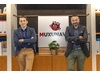
POWERBIM is one of the success stories of Foro Capital Pymes. The company successfully completed part of its latest funding round through investors introduced by Foro Capital Pymes.
POWERBIM is a technology company specializing in digital twins, helping organizations transform the management of buildings and infrastructure by integrating BIM, IoT sensors, and artificial intelligence.
Following the successful completion of a recent funding round, we spoke with the company's CEO to learn more about POWERBIM's evolution, the challenges of digitalization in the construction industry, and the opportunities emerging in the rapidly growing digital twin market.
I'm an architect by training, and my career began working at several architecture firms on both national and international projects. While working in the Middle East, I discovered what BIM looked like when fully implemented. In Spain, BIM was still in its early stages and had not yet been widely adopted.
There I learned to work with BIM methodology, which allows you to virtually construct a building before it exists by creating a digital information model. What really struck me was realizing that these models are essentially comprehensive databases of the building.
Based on that experience, I decided to become an entrepreneur and founded a BIM company called BIM6D. We initially focused on technology consulting services, but in 2019 we launched our first software product as a spin-off. At that time, however, the market wasn't ready.
The real opportunity came during the COVID-19 pandemic, when we worked on emergency hospital projects. Our platform enabled remote site monitoring through cameras and virtual walkthroughs, and that's when the digital twin concept truly gained momentum.
From that point on, we evolved into a platform that combines BIM with real-time data from sensors, energy systems, maintenance, security, and cameras. We started with buildings, but today we also work with infrastructure and smart cities across both the public and private sectors.
We didn't intentionally target them, but naturally we ended up working with large buildings because they present the greatest operational and management challenges.
Our platform focuses on solving operations and maintenance issues, which represent the largest portion of a building's lifecycle costs—often over a period of 50 years.
We help optimize those costs through analytics, simulations, and performance improvements. In a way, what we do is diagnose a building, much like a doctor diagnoses a patient, identifying where it's underperforming so corrective actions can be taken.
Our main differentiator is that we combine a pioneering digital twin platform with deep industry expertise.
Digital twin technology is applicable across many industries, but we focus exclusively on construction and building management. That gives us a very clear vertical specialization.
We're also a unique combination of technology and industry knowledge, bringing together architects, engineers, and software developers. This allows us to truly understand our customers' challenges.
In addition, we entered the market early, giving us a competitive advantage even against large technology companies.
Construction remains one of the least digitalized industries. Progress has been made, but not at the pace required.
There is still considerable resistance to change. Many companies see BIM as an additional cost rather than a strategic investment. The problem is that they don't experience its return on investment because they use BIM merely as a drawing tool instead of connecting it to the physical building.
The real value emerges when the digital model is connected to the actual asset. That's when you can monitor, diagnose, and optimize building performance.
Companies that fail to embrace this evolution risk being left behind as the industry's transformation accelerates worldwide.
The global digital twin market is growing at an exceptionally fast pace, even outpacing the construction industry itself.
We operate at the intersection of BIM and digital twins, placing us in a highly strategic position.
The opportunity is enormous because there are still relatively few players in this space. Companies entering now will enjoy a significant competitive advantage in the years ahead.
The biggest lesson is to validate your idea with the market as early as possible.
Technology companies often fall in love with their solution, but what truly matters is testing it with real customers. Having a great idea isn't enough—you need to prove that it solves a genuine problem and that customers are willing to pay for it.
We've had to pivot several times before finding the product-market fit that the market truly demanded.
It was a long and challenging process. We initially aimed to raise €2 million, but eventually adjusted our expectations and successfully closed a €1 million round in two stages.
The biggest challenge was finding investors who genuinely understood what we do. Many recognized the potential but struggled to assess its value.
It played a key role. Foro Capital Pymes gave us credibility, screening, and structure at a crucial stage of the process. It wasn't just a platform where we presented our project—it also helped us refine our messaging, strengthen our pitch, and focus on what truly mattered to investors.
It was also instrumental in connecting us with the first investor who joined the round, helping unlock the process and build confidence among other prospective investors.
The support we received afterward was equally valuable, particularly during the follow-up, negotiation, and closing phases of the funding round.
It was both demanding and extremely valuable.
The preparation helped us better articulate our value proposition, clearly explain the problem we solve, and present POWERBIM's potential in a way that investors could easily understand.
It also enabled us to organize our key messages, review our financial figures, anticipate potential questions, and prepare a much more focused, business-oriented presentation. That preparation gave us greater confidence and a much clearer narrative when presenting at the forum.
Our goal is to evolve the platform into a more open, automated solution built around native artificial intelligence.
We're transitioning to a more flexible and scalable SaaS model with usage-based pricing, allowing us to serve a broader customer base while accelerating our international expansion.
We also want to promote education around digital twins, as the widespread adoption of this technology still requires significant industry awareness and training.
Several milestones stand out: securing our first customers, surpassing €1 million in revenue during our early years, receiving international innovation awards, and, above all, evolving our technology toward AI-powered digital twins.
Absolutely—especially to innovative companies looking for investment but unsure where to begin. It's an excellent gateway into the investment ecosystem.
POWERBIM's journey illustrates how the construction industry is evolving through technologies such as BIM, digital twins, and artificial intelligence. The company has successfully transformed from a technology services provider into the developer of its own platform, focused on optimizing the entire lifecycle of buildings, with particular emphasis on operations and maintenance.
The team's experience highlights the importance of validating solutions with real customers, adapting products to market needs, and maintaining flexibility throughout growth and fundraising processes. In this regard, the recent investment round marks a significant milestone that will accelerate both the company's technological development and its international expansion.
In an industry that still has substantial room for digital transformation, POWERBIM occupies a highly strategic position with strong growth potential. Its combination of technical expertise and innovation places the company in an excellent position to help lead the industry's transformation in the years ahead.

cloud technology axon
Cuatrecasas has advised Vicinay Marine Group, a global leader in the d...