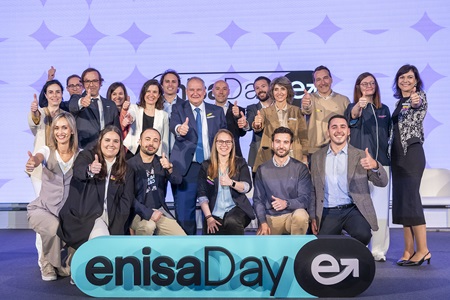
On the occasion of this milestone in its trajectory, ENISA held EnisaDay at Matadero Madrid, a gathering that brought together funded companies, representatives from public and private institutions, and the organisation’s staff. The event featured the participation of Jordi Hereu, Minister of Industry and Tourism.
During his speech, the minister highlighted ENISA’s structural impact on the Spanish economy, stressing its role as an instrument supporting those who choose to create and scale innovative companies. “Vision, sustained effort and collective work have enabled ENISA to turn the projects of thousands of entrepreneurs into business realities. It has done so by mobilising more than €1.5 billion. Without ENISA, Spain would not be the same: more than 8,400 companies would not have contributed so decisively to GDP generation and quality employment,” he stated, underlining how ENISA transforms entrepreneurial talent into tangible impact.
For her part, Teresa Parejo, Director General for Industrial Strategy and SMEs at the Ministry of Industry and Tourism and Chair of ENISA, announced that “the availability of financing for ENISA is guaranteed beyond the timeframe of the Recovery, Transformation and Resilience Plan (PRTR) funds, which allows us to consolidate a stable model of public support for entrepreneurship and innovative SMEs in Spain, in which the National Innovation Company will continue to play an active role as an instrument serving this shared objective.”
ENISA CEO Carolina Rodríguez noted that this milestone is the result of a consolidated public policy based on innovation as a lever for competitiveness and economic transformation. “ENISA acts as a starting point for many business projects, enabling companies to progressively access other public and private financing instruments as they grow. ENISA is the public cornerstone that activates new financing pathways and supports business development, turning talent into real economic activity and skilled employment,” she said.
Over nearly 45 years of activity, the National Innovation Company (ENISA), under the Ministry of Industry and Tourism, has become a stable public policy tool, supporting thousands of companies in their early stages through tailored financial instruments. It has contributed to the development of entrepreneurial ecosystems across Spain and to the strengthening of the productive fabric, as well as to a gradual transition towards a more innovative, competitive and knowledge-based economy.
This leadership also enjoys international recognition. The OECD report Entrepreneurial Ecosystem Diagnostics of Spain places Spain among the most dynamic entrepreneurial ecosystems in Europe and acknowledges ENISA’s strategic role in consolidating the Startup Law framework and leading the next stages of the entrepreneurial ecosystem. The organisation highlights ENISA’s sustained contribution to venture financing and its role as a certifying body for startups. To date, more than 2,200 companies have obtained this certification, essential for fostering an environment conducive to growth, innovation and competitiveness.
A nationwide impact
ENISA’s activity reflects the diversity and reach of innovative entrepreneurship in Spain. In this context, the Minister of Industry and Tourism stressed that “public financing, in collaboration with private initiative, is key to strengthening competitiveness, territorial cohesion and the international projection of our country.”
By autonomous communities, the Community of Madrid (€468M) and Catalonia (€467.6M) account for the largest share of financing, followed by the Valencian Community (€116.6M), Andalusia (€104.8M), the Basque Country (€71.6M), the Region of Murcia (€35.3M), Galicia (€41.9M), Aragón (€33.8M), Castile and León (€33.1M), Castile-La Mancha (€27.7M), the Principality of Asturias (€23.7M), Navarre (€25.3M), the Balearic Islands (€15.9M), Extremadura (€14.1M), the Canary Islands (€10.5M), Cantabria (€9.2M), La Rioja (€7.7M), and Ceuta (€190k).
European funds and strategic programmes
One of the most significant developments in ENISA’s recent evolution has been the management of participative loans through the Recovery and Resilience Mechanism of the Recovery, Transformation and Resilience Plan (PRTR), financed with European funds. This approach has eliminated seasonality and ensured permanent availability of financing, strengthening the predictability and stability of the public instrument within the Ministry of Industry and Tourism’s broader commitment to supporting innovation and business risk-taking.
In addition, ENISA has developed strategic programmes aimed at reducing social, sectoral and territorial gaps, such as Digital Entrepreneurs, promoting female entrepreneurship with funding from the Ministry for Digital Transformation and Civil Service; AgroInnpulso, focused on the digitalisation of the agri-food sector and rural areas, funded by the Ministry of Agriculture, Fisheries and Food; and Audiovisual and Cultural and Creative Industries, under the Spain Audiovisual Hub Plan, funded by the Ministry for Digital Transformation and Civil Service and the Ministry of Culture.
EnisaDay: a meeting point to share, connect and grow
Beyond the financial milestone, EnisaDay was created as a space to connect different stakeholders across Spain’s business ecosystem and to highlight a collective project built on talent, vision and commitment, recognising entrepreneurs and companies as drivers of economic and social progress.
The event showcased ENISA-funded companies representing territorial, sectoral and maturity diversity, from early-stage projects such as Gimme Sabor to scaling companies such as Sycai Medical or Coinscrap. It also featured established players such as Cooltra and Brooklyn Fitboxing, as well as cutting-edge tech initiatives such as PLD Space and Sateliot. The programme was completed by impact-driven projects such as Universal DX and Senniors.
Together, these cases demonstrate how well-designed, stable and long-term public policy can support companies throughout all stages of their development.
About ENISA
ENISA is a public entity attached to the Ministry of Industry and Tourism whose mission is to support innovative and viable projects from Spanish startups and SMEs, facilitating their development and competitiveness in global markets.
It provides participative loans ranging from €25,000 to €1.5 million, without requiring collateral or guarantees beyond a solid project and the professional solvency of the management team.
It also acts as a certifying body for startups seeking to benefit from the incentives of the Startup Law, a pioneering regulation in Europe.
In 2025, ENISA granted 514 loans for a total of €86.2 million. The average financing amount is around €167,000.
Historically, ENISA has granted 9,700 loans to more than 8,400 companies, with a total investment of €1.5 billion.

cloud technology axon

Ultimately, my advice on LOIs is very similar to the advice I give cli...