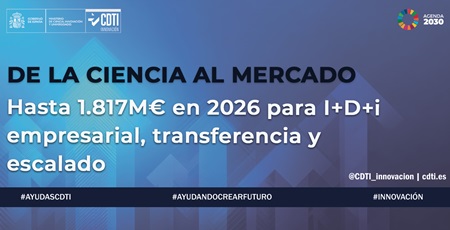
CDTI Innovación, the State Innovation Agency of Spain’s Ministerio de Ciencia, Innovación y Universidades (Ministry of Science, Innovation and Universities), plans to allocate up to €1.817 billion in 2026 to strengthen the full innovation cycle — from the creation and consolidation of new technology-based companies, the acceleration of challenge-driven collaborative R&D, the promotion of early-demand R&D and validation of prototypes in real environments, to the mobilisation of public capital through public-private co-investment and fund operations. The overarching objective is to ensure that Spanish R&D results are transformed into competitive and sustainable growth through market-ready solutions that deliver value to citizens.
Specifically, CDTI Innovación would allocate up to €407 million in grants, €75 million to innovative public procurement, €32 million to international cooperative innovation actions, €545 million to partially repayable funding instruments, and approximately €790 million in direct (co-investments) and indirect (funds) investment aimed at scaling innovative companies and disruptive technologies to bring R&D results to market.
Within the framework of the Spanish Science, Technology and Innovation Strategy 2021–2027, CDTI Innovación acts as a driving agent, increasing average grant intensity and diversifying financing instruments to adapt to the nature of each business R&D and innovation project. Its actions aim to position Spain as a European leader in knowledge transfer. For decades, its R&D&I programmes have also included initiatives focused on dual-use technologies — applicable in both civilian and defence contexts — generating synergies and reducing development costs, managed through a dedicated department.
With a portfolio-based approach rather than isolated programmes, CDTI Innovación structures its actions according to each project’s technological risk, maturity, collaboration needs and scaling potential. Its public intervention goes beyond grants, building instruments to address bottlenecks at different stages of development:
In 2026, through a comprehensive portfolio combining competitive grants, international cooperation support, innovative public procurement, partially repayable funding and venture capital investment, CDTI Innovación will provide tailored support across all levels of technological maturity.
Competitive grants focus on the highest-risk stage — transforming knowledge into demonstrable technology and subsequently into products or services. The NEOTEC programme would receive up to €40 million to support the creation and consolidation of R&D-intensive technology-based companies, reinforcing innovative entrepreneurship and deep-tech development aligned with strategic capabilities and technological sovereignty.
The MISIONES CIENCIA E INNOVACIÓN call could be endowed with up to €145 million to promote large collaborative R&D projects, typically structured as consortia addressing socio-economic challenges such as sustainability, energy transition, health, security and defence. Misiones acts as a flagship programme, mobilising value chains and accelerating the transition from applied research to market deployment.
INTERCONECTA-STEP will receive €70 million to support high-tech solutions through public-private collaboration and regional innovation ecosystems, aligned with European industrial capacity priorities in digital technologies, clean and resource-efficient technologies, and biotechnology (including essential medicines).
The CERVERA programme, with up to €50 million, strengthens the role of technology and excellence centres as bridges between knowledge and industry, reinforcing applied technological capabilities and facilitating business access to advanced technologies and specialised talent.
Complementing this ecosystem approach, Innovation and Transfer Ecosystems will connect knowledge-generating institutions, companies, public administrations and users around socio-technical challenges solvable through R&D&I.
The INNOGLOBAL call, endowed with €15 million, promotes international technological cooperation and participation in high-potential transnational projects, reinforcing the global dimension of innovative growth.
Overall, competitive grants prioritise intensity, focus, collaboration, critical mass and accelerated market impact, with dual-use technologies serving as a cross-cutting priority criterion.
CDTI will allocate €32 million in direct-award actions to support internationalisation and projects evaluated in competitive external frameworks. This includes support for Eurostars, European partnerships, a bilateral call with Korea (€17 million), and the Seal of Excellence scheme (€15 million), ensuring continuity for high-quality projects even when international funding is unavailable.
The third strategic lever, with €75 million in 2026, is pre-commercial innovative public procurement for high-tech prototypes and demonstrators (digital health, autonomous mobility, clean energy, food security). This mechanism introduces real demand and early validation, reducing market risk and accelerating adoption while enabling public administrations to address strategic challenges through innovation.
CDTI will allocate €545 million to partially repayable loans (APRs), which include a non-repayable grant-equivalent component. These soft loans provide continuity for incremental innovation projects with lower market risk, enabling companies to sustain and scale technological investment with greater financial predictability.
Finally, the INNVIERTE programme will mobilise €790 million in direct and indirect investment to support the creation and growth of innovative companies. INNVIERTE addresses capital and scaling bottlenecks, catalysing private investment and facilitating internationalisation and industrial scalability, ensuring that R&D results translate into competitive companies
About CDTI
The Centre for the Development of Technology and Innovation (CDTI E.P.E.) is Spain’s national innovation agency under the Ministry of Science, Innovation and Universities. Its mission is to promote technological innovation in the business sector, enabling Spanish companies to transform scientific and technical knowledge into globally competitive, sustainable and inclusive growth. In 2024, under its new strategic plan, CDTI provided more than €2.3 billion in support to Spanish companies and startups.

cloud technology axon

Dental Company has established itself as one of the leading dental net...