
Regulatory evolution to improve the customer journey for a competitive & stronger Digital Single Market
In today’s digital ecosystem, telecom services have become indispensable for citizens and businesses. However, the rules of yesterday’s economy continue to govern the sector in Europe, and this is holding back telecom operators, hampering industrial users, and confusing consumers.
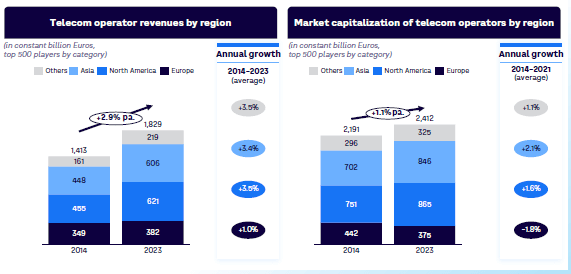
Telecommunications provides the essential infrastructure and connectivity that supports innovation, growth, and digital inclusion. It is the backbone of all EU industries, and European consumers have benefited from greater service access, unlimited usage, and much faster network speeds. However, European telecom operators are now experiencing the lowest growth among digital players despite relatively higher investment and are underperforming across key performance metrics compared to their global peers. So how can Europe transform its telecom regulations to create a sector fit for the future?
Europe’s Digital Decade policy program lays out four pillars that it says will support the EU in creating a new era of innovation and competitiveness: (1) digital skills, (2) developing secure digital infrastructures, (3) digitizing business, and (4) transforming public services. Advanced connectivity networks and services are at the center of this policy framework.
At the same time, the European Commission is working on a reevaluation of the European Electronic Communications Code (EECC) with a view to proposing a new Digital Networks Act that would help drive innovation and competitiveness. Europe’s ability to meet its Digital Decade targets will depend on whether this bill reboots the regulatory framework enough to make it coherent, proportionate, and aligned with market realities.
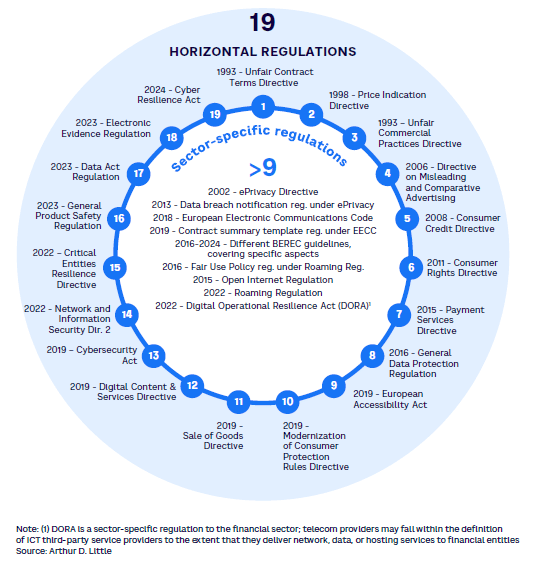
Europe’s current regulatory framework has been built up over decades through both horizontal and sector-specific legislation. It has successfully supported liberalization, competition, and consumer choice in the past, but it has become increasingly misaligned with today’s market and technological realities.
Layered, fragmented, and asymmetrical obligations across nations have created a complex compliance environment that limits operators’ flexibility, slows down innovation, and undermines their ability to invest at scale. Looking at the whole customer journey, telecom operators must comply with a patchwork of 34 sets of regulatory obligations — from customer acquisition to service delivery, as a result of a complex mix of over 28 European horizontal and sector-specific regulations (notwithstanding national laws), with nearly half overlapping.
This has left the industry facing three core structural challenges that any regulatory rewiring must tackle:
Arthur D. Little’s latest report “A Simplification Agenda for European Telecoms” — published jointly with Connect Europe — proposes a reform package to tackle these three key problem areas:
1. Simplify obligations to tackle overregulation. Remove sector-specific requirements under the EECC and rely on horizontal consumer protection. This would help create a unified, streamlined regulatory framework that would reduce compliance costs, lower legal uncertainty, and increase transparency for consumers.
Precontractual information and transparency rules should focus on information that directly enables consumer decision-making, rather than overly technical disclosures. This is essential wherever consumer protection can be preserved or even enhanced through horizontal rules, improved coordination, or better-targeted sector-specific measures.
Europe also needs to abolish its universal service obligations (USO). Market conditions today already ensure the coverage and affordability this was designed to provide. Operator-funded USOs should be replaced with targeted public funding models through the use of broadband vouchers or targeted state aid to support connectivity. This would ensure that public policy focuses on actual connectivity challenges without penalizing telecom operators, while safeguarding the benefits for the customer.
2. Level the playing field for telecom providers and native digital service providers. This can be done in two ways: (1) reduce or simplify obligations where existing rules have become disproportionate or outdated; and (2) extend justified, up-to-date, and relevant obligations to actors, such as big tech firms, that fall outside the regulatory framework.
The principle of functional equivalence should be applied thoughtfully to ensure that users benefit from consistent levels of protection across services that are substitutable in practice. Legacy telecom-specific rules should only be extended across all actors where they cover required customer protection and privacy-protection obligations, including provider switching rules and the principle of confidentiality of communications.
The priority should be to reevaluate whether existing sector-specific obligations remain proportionate and necessary. Leveling the playing field in this way would remove unjustified advantages for certain players and restore fair competition.
3. Pursue regulatory harmonization with stronger enforcement. The currentfragmentation in the way regulations are interpreted and applied across Member States must be addressed to realize the Digital Single Market’s full potential. This means today’s institutional framework must be reassessed to improve regulatory consistency across EU nations. There must be mutual recognition of requirements across Member States and promote international standards to ease compliance.
Uniform interpretation — and enforcement — of these rules would help operators to design cross-border offers efficiently, fostering consumer trust and promoting competition, preserving the integrity of the Digital Single Market. Prioritizing the use of directly applicable EU regulations over directives in future telecom and digital legislation would help achieve this.
Regulatory clarity, fairness, and consistency are not only administrative concerns — they are critical enablers of competitiveness and will be pivotal to whether the EU and its telecom sector can step into the future and achieve its Digital Decade targets for 2030, rather than remain bound by the past.
Making the right changes would unlock innovation, enable scale, and restore competitiveness, creating benefits that would be felt not just by telecom providers but by users across the continent.

cloud technology axon

Global M&A activity remained resilient during the first half of 2026, ...