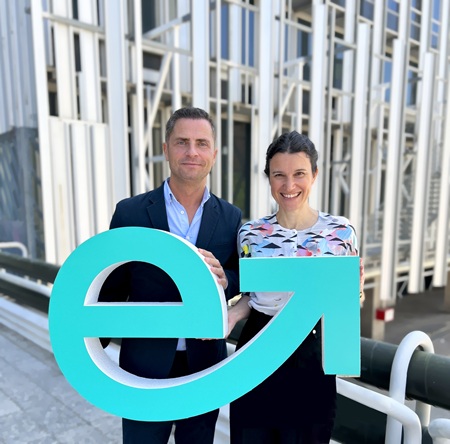
Enisa, the leading public entity for financing and attached to the Ministry of Industry and Tourism, closes the first half of 2025 with significant developments and the departure of its CEO, Borja Cabezón. Since taking over Enisa’s leadership in January 2024, Borja Cabezón has brought fresh momentum to the organization, introducing a management model that combines institutional consolidation of the Enisa brand with a strong focus on proximity to and engagement with Spanish SMEs and the people behind them.
Over these 18 months, Enisa has strengthened its role as a key and useful public instrument in financing startups and innovative SMEs, fully aligned with the strategic directives of the Ministry of Industry and Tourism.
To support this progress, Enisa approved its new 2024–2026 Strategic Plan, developed with the participation of all departments within the organization and stakeholders from the broader ecosystem. This plan sets the framework for Enisa’s activity in the coming years, focusing on financing tailored to SMEs' real needs, fostering entrepreneurship across the country, and providing value-added services beyond financial support.
However, the most noteworthy development is the launch of a new financing mechanism, thanks to the leadership and commitment of Borja Cabezón. This mechanism increases Enisa’s financial capacity, eliminates seasonality, and ensures continuous availability of funds—addressing a long-standing demand from the Spanish innovation ecosystem.
Another major milestone during this period was the signing of a guarantee agreement with the European Investment Fund (EIF), aimed at reducing access barriers to financing for startups and innovative SMEs.
One of Borja Cabezón’s defining characteristics has been his dedication and active engagement across the country: more than 50 trips, nearly 100 appearances at public events, and 70 media activities reflect his determination to bring Enisa closer to every corner of Spain, to listen to ecosystem players, to forge public-private alliances, and to highlight the impact of public funding on the development of Spain’s entrepreneurial fabric.
He also made a clear commitment to recognizing and promoting internal talent, fostering a leadership model that values team commitment and experience. Under his direction, a leadership team was consolidated, made up of professionals with long-standing careers at Enisa. This helped strengthen internal cohesion, ensure operational continuity, and solidify a shared institutional vision.
In line with this continuity, Carolina Rodríguez Arias—Enisa’s current Director of Coordination, with ten years of experience in the organization and deep knowledge of the national innovation ecosystem—will succeed him as CEO. She was part of the team at the High Commissioner for Spain Entrepreneurial Nation, and in her last role as General Director, contributed to the successful approval of the Startup Law in December 2022.
On the operational front, Enisa approved 508 participative loans in 2024, totaling €83.6 million, with an average amount of €164,570. Additionally, by the end of Borja Cabezón’s term, nearly 1,700 startups had been certified to access the benefits offered by the Startup Law. These figures demonstrate the confidence that Spanish SMEs and ecosystem stakeholders place in Enisa, positioning it as an essential public tool to support and strengthen Spanish startups and SMEs, contributing actively to the economic and social transformation of the country.
About EnisaT
he National Innovation Company (Enisa) is a public entity under the Ministry of Industry and Tourism of Spain. Its mission is to ensure that viable and innovative projects—led by entrepreneurs and Spanish SMEs—secure the funding they need to develop and compete in a global market.
This financial support is provided through participative loans ranging from €25,000 to €1.5 million. These loans are a flexible financing alternative tailored to SMEs’ needs and require no additional collateral—just a solid business plan and a professionally capable management team.
Additionally, Enisa serves as the certifying body for emerging companies wishing to benefit from the tax incentives and regulatory advantages established under Spain’s Startup Law—a pioneering legal framework in Europe that fosters startup growth and success. To date, nearly 1,700 emerging companies have been certified.
Since Enisa began granting participative loans, it has issued over 9,360 loans, financing more than 8,130 companies, with a total investment exceeding €1.44 billion.
More info: www.enisa.es
Image: Borja Cabezón and Carolina Rodríguez

cloud technology axon
Global M&A activity remained resilient during the first half of 2026, ...